Wednesday, May 11, 2011

How sweet it is.

(Acknowledgement: This post was greatly improved by the input of nutrition-guru, Tess McEnulty. Thanks, Tess!)

Go to any bookstore, pick up any lifestyle magazine, or watch pretty much any talk show, and you will get advice on how to eat. Most of this advice mimics the USDAs new food pyramid and nutrition guidelines. We are all familiar with this advice: eat fewer calories, avoid foods that are high in cholesterol or fat (especially saturated or trans fats), and eat lots of fruits, vegetables, whole grains, and lean meats and dairy.

Perhaps you have also heard that unprocessed foods are better than their processed counterparts. Oranges, for example, are better for you than orange juice according to Michael Pollan’s In Defense of Food. Local, organic, and seasonal are also associated with healthy foods. These fruits and vegetables have to make it to consumers quickly or they spoil. That extra freshness likely translates to higher nutrition.

Despite all of this information, we still have an increasingly obese population. Certainly some people simply choose to eat poorly. But we all have friends (or even have experienced this ourselves) who seem to follow all the rules and still have trouble losing weight. In recent years, several theories have come out suggesting that perhaps our idea of what constitutes a healthy diet is actually flawed. Three notable people at the center of these investigations are Gary Taubes, Robert Lustig, and Loren Cordain. In many ways, their conclusions are similar, but each one has focused on a different aspect of why and how we gain and lose weight.

Forget about calories. And fat. Oh, and cholesterol too.

Science writer, Gary Taubes, has done extensive research into the scientific case linking the consumption of fatty foods and cholesterol to obesity and heart disease. As reported in his 700-page book, Good Calories, Bad Calories, Taubes found the so-called evidence unconvincing. Instead, he learned that our bodies’ ability to regulate blood sugar seems to hold the key to keeping us healthy. The connection between fat storage and insulin response is better at explaining why certain cultures are healthier than others. Consuming refined carbs and sugars, which play a large role in our Western diet, triggers an insulin response and ultimately lead to metabolic diseases such as Type 2 diabetes and obesity.

When it comes to losing weight, Taubes dismisses the notion of calorie counting. We often think of weight loss, or more specifically fat loss, as an equation. How much you weigh equals the calories you take in minus the calories you burn through regular activity or exercise. If that were true, simply reducing calorie intake or increasing calorie burn should lead directly to fat loss. However, if your body chooses whether to store or burn fat based on hormones and insulin levels, then reducing calories won’t necessarily allow you to lose more fat. The key is to keep your insulin levels low, so that your body responds more sensitively to insulin and is willing to give up the fat.

The best way to keep your insulin levels low is by vastly reducing your intake of refined carbs and sugars. Eat as much as you want, but eat the right foods: plenty of vegetables (especially the green leafy kind), quality animal proteins, nuts, and nut butters. Legumes, whole dairy, or whole grains are probably fine for most people, especially those at their target weights, but they may inhibit weight loss.

A recent article in Men’s Journal (my dad sent me a copy), covered Taubes’ diet guidelines in a bit more detail than I will here. They offer recipes, a sample week-long meal plan, and this Taubes-style food pyramid.


Endocrinologist and professor, Robert Lustig, is also concerned about the effects of insulin resistance on weight and health. He is focusing mainly on the effects of fructose, the type of sugar found naturally in fruit and honey and in the form of high fructose corn syrup (HFCS), which now appears in many processed foods from soda to bread.

Fructose is processed in the liver, which Lustig believes can only handle so much fructose at one time. When we eat fruit, the fiber it contains helps the liver process the fructose – not the case when we consume fructose in other forms such as soda and other sweetened beverages. In a popular YouTube video, Lustig explains that over-consumption of fructose can lead to liver disease, metabolic syndrome, and eventually, obesity and it’s accompanying problems. Unlike the average 15g of fructose that most people would get from daily consumption of fruits and vegetables, today’s teens average 72g per day from other sources like soda and junk food.

So yummy, a cave man could eat it.

As I mentioned in my previous post, Loren Cordain is one of the main proponents of The Paleo Diet. The philosophy behind Paleo is to consume only those foods that we have been eating since before the agricultural revolution. The foods we survived on as hunter-gatherers are the foods we evolved to consume, so our bodies are better able to tolerate them and utilize their nutrients. The Paleo Diet differs a bit from the Taubes-Lustig paradigm. People following the Paleo diet do not eat grains, dairy, or legumes. The refined carbs and sugars that Taubes and Lustig are warning us about are certainly excluded in this diet, but starchy vegetables and fruit are considered okay in moderation.

There is now a great deal of work looking into why exactly the classic hunter-gatherer foods are healthy while many newer ones are not. Research suggests that some agriculture-based foods contain so-called anti-nutrients. These are natural defense mechanisms that certain plants employ to keep from being eaten. Despite our cleverness at making these foods edible, they may actually lead to many chronic health problems such as auto-immune disorders, asthma, and more.

Switching to a Paleo diet may sound rather daunting especially compared to the typical American diet. It took me about a year to transition from pizza and soda to a veggie-centric diet. Slowly but surely, though, anyone can make the switch. Even with all the changes I have made, this trio of nutrition experts has caused me to wonder just how healthy my diet really is.

How do I stack up?

Based on the USDA guidelines, I eat a healthy diet. I consume a lot of vegetables, cook most of my meals, and haven’t eaten at a fast food restaurant or ordered a restaurant burger in years. But how much sugar is in my “healthy” diet?

The following table shows what foods I typically eat for breakfast, lunch and dinner, plus snacks and dessert. While some of my food choices would certainly be Lustig-approved (my English muffin plus peanut butter has a mere 1.5g of sugar), nearly all my snack choices have 13-19g of sugar despite being healthy-sounding foods. If I chose the lowest sugar option for each meal and had only one snack, my total sugar intake for the day would still be close to 30g. With the highest-sugar options, my daily intake of sugar would be nearly 120g!

Unfortunately, there is no USDA daily recommended intake of sugar. The American Heart Association does have a recommendation though: 20g of added sugar per day for women and 36g for men. Even my lowest sugar options would be too high by this measure. And although many of my sugars are from fruit (so not added sugars), one granola bar is basically my whole sugar allotment for the day.

Another way of visualizing sugar is by comparing it to things we perceive as being sweet treats. The website, Sugar Stacks, goes one step further by showing popular foods next to the equivalent number of little white sugar cubes. My daily sugar intake is on par with a liter bottle of soda, 2 Rockstar energy drinks, or 2-3 bags of Skittles. On the one hand, that seems like a lot sugar for natural healthy foods. On the other hand, a college freshman who consumes a couple of energy drinks has ingested as much sugar as I eat in a whole day! Either way you look at it, we are getting a lot of sugar.

Knowledge is power.

My sugar intake is lower than the average American, who apparently consumes a staggering 90 pounds of sugar each year (that’s >100g every single day), but it may still be too high. Now that I know, I can make better choices. For example, topping my salad with 2T of fresh blueberries rather than 1.5T of raisins would reduce my sugar intake by 8.6g. Sticking with black coffee or tea instead of a latte reduces it by 17g. And eating my tuna salad over mixed greens with a little balsamic vinegar rather than as a sandwich saves me another 5.4g - and I get my greens!

Snacking seems to be my worst area. Here are some easy snacking alternatives that would really make a difference in my diet. Rather than a granola bar or fruit (13-19g of sugar), I could eat:

  • 2T hummus and 1 chopped carrot, 5g
  • Trader Joe’s Roasted seaweed snack, 0g
  • 1/2 English muffin with 1T peanut butter, 1.5g
  • 1/4 cup raw almonds, walnuts, or cashews, 0-2g

Cordain, Taubes, and Lustig offer a glimpse into a real-food loving future. Imagine, you can eat all you want and not get fat. You can enjoy a big juicy steak, cashews, avocados, even scrambled eggs and bacon. You can stop worrying about cholesterol and calories. All you have to do is give up the sugar. Sounds like a pretty sweet deal.

Additional resources:
- Gary Taubes recently wrote an article in The New York Times about Lustig and his work
- The recipes for my dinner options have been featured in previous posts: 15-minute fish and hearty black bean stew

Sunday, May 1, 2011

Eat by numbers.

Nutrition has been making the news a lot lately, and for good reason. Heart disease, type 2 diabetes, and obesity are becoming increasingly prevalent. The rise in childhood obesity is especially disturbing. According to the Center for Weight and Health in Berkeley, 11% of California’s children are obese – defined as having a Body Mass Index (BMI) in the 95th percentile or higher. Over 30% of adolescents in California are obese or in danger of becoming obese (>85th percentile).

The problems are obvious, but the solutions aren’t so clear. We know we need to get more exercise and change our diets. Unfortunately, what constitutes proper nutrition and healthy food can be difficult to discern. Marketing schemes further muddy the waters because products marketed as healthy in one respect are often quite unhealthy in another.

If we want truly healthy foods to be readily available, we have to demand them as consumers. That means we need the public to understand what foods are healthy and be able to quickly and easily evaluate foods when they shop. People may not always choose healthy options (and that’s fine), but they should be able to know what choice they are making.

Easy access to clear information is the idea behind NuVal, a new food rating system. Designed by doctors, foods are ranked using a mathematical algorithm that compares the nutritional pros and cons of many grocery store products. A food product with a rating of 1 has virtually no nutritional value; a 100 is the best score. The goal is to have the NuVal score printed alongside the price in the grocery store, giving people a clear way of determining the best product based on their nutritional and economic values.

Scores for a selection of foods are shown on NuVal’s website. Blueberries, broccoli, tomatoes, mangos, and certain brands of frozen winter squash, fat free milk, and wheat bran cereals are some of the best scoring product, with scores between 91 and 100. Unsurprisingly, crackers, cookies, and salty snacks make up most of the bottom.

What’s especially powerful about this type of labeling system is that it allows people to easy identify nutritious foods despite the creativity of food marketers. I found several healthy-sounding foods with pathetically low scores. Keebler Townhouse Bistro Multigrain crackers received a score of only 2; Cheetos at least got a 4. Kashi Strawberry Fields cereal scored an 11, beating out Cap’n Crunch by a mere 1 point. There are even a few canned vegetables that perform incredibly badly, probably due to excess sodium.

The NuVal system seems like a great idea, but it is based on one interpretation of what it means to be healthy. The current algorithm seems to follow the big picture USDA guidelines. As quoted from the USDA website, the recommended diet:

  • Emphasizes fruits, vegetables, whole grains, and fat-free or low-fat milk and milk products;
  • Includes lean meats, poultry, fish, beans, eggs, and nuts; and
  • Is low in saturated fats, trans fats, cholesterol, salt (sodium), and added sugars.

Over time, we may determine that the diet recommended for the USDA and adopted by NuVal is not as complete. For example, the Paleo diet has been gaining traction lately, especially in athletic communities. Pioneered by Dr. Loren Cordain, the Paleo diet recommends that we minimize our intake of fruit due to its high (albeit natural) sugar content and avoid grains and dairy, which humans have only starting eating relatively recently.

For now, though, the NuVal approach seems like a good first step. Perhaps some day, the majority of foods at the grocery store will score high on the NuVal chart, and then we can worry about further distinguishing the best options from the good options. Only a few stores have incorporated the NuVal scoring system so far. You can find the stores on their website as well as info on recommending the system to your local store.

NuVal will not be the sole solution to our nutrition problems, but it is the first system I’ve seen that could really empower consumers to make healthy choices and vote with their dollars every time they go to the store. Having the scores so prominently displayed is also likely to generate interest in nutrition issues and hopefully engage the public in the way our food system operates. And that’s a pretty high scoring outcome in my book!

Sunday, April 17, 2011

Tobacco subsidies, up in smoke.

My investigations into the food system generally result in depression and/or anger. When I decided to take on tobacco subsidies, I had a feeling it would at least ruin my weekend. Just goes to show, you never know the answer until you ask the question.

After the great depression, programs like farm subsidies and crop insurance were instituted to protect people (both growers and consumers) from volatile crop prices. The program for tobacco restricted the size and location of tobacco farms as well as the amount of tobacco that could be grown on any one farm. The idea was to regulate the supply of tobacco to keep the price steady over many years. If the price of tobacco fell despite the quotas, farmers could use their crops as collateral on a loan from the government. The loans were generally repaid over the next few growing seasons as the price rebounded.

In 1982, as people were learning that tobacco products are extremely addictive and lead directly to many forms of cancer, there was a public outcry. People did not want the government supporting tobacco farming with their tax dollars. The No-Net-Cost Tobacco Program was the result: growers and buyers shared the cost of a small fee added to all marketed tobacco. The fee was used to defray the costs of loans that were not repaid. Thus, although the loan program continued to help regulate the market and thereby supported tobacco farming in the US, it wasn’t costing the taxpayers money. At least, it wasn’t supposed to…

Administrative costs for the program remained the responsibility of the government. The government also paid tobacco farmers additional money in response to agricultural and natural disasters. In years when the prices of tobacco and other commodities were especially low, the government again authorized payments to farmers that came from taxpayer dollars. Administrative costs, and these extra payments, ran in the hundreds of millions. It’s a tiny fraction of the federal budget but still a lot of government money for a “no-cost” program.

Over time, domestic demand for tobacco continued to fall, causing the price to also fall. In response, the government reduced the quotas on tobacco production, thereby decreasing supply, in order to bolster tobacco prices. At the same time, however, tobacco farming from outside the US became increasingly competitive, and the US tobacco market suffered even more. It became clear that the old quota and loan system was no longer effective.

In 2005, President George W. Bush enacted the Tobacco Transition Payment Program (the “tobacco buyout”). The act eliminated regulations on the size and location of tobacco farms, crop quotas, and the loan program. Instead, starting in 2005 and continuing for the next 10 years, tobacco farmers receive a direct payment subsidy based on the amount of tobacco they grew in the years before the buyout. After this ten-year period, tobacco farmers will receive no financial assistance from the government.

With the money from the tobacco buyout, farmers can choose to transition to another crop, consolidate or expand their tobacco operations to become more efficient, or give up the farming business altogether. The buyout seems like a good way of transitioning farmers away from tobacco, but how much is it costing us?

Nothing. That’s right. The $10 billion that will be spent on direct payments to tobacco farmers is being paid by the manufacturers and importers of tobacco products. In exchange, these companies do not have to pay part of a health-based court settlement.

I wasn’t able to find any information on the environmental impact of more consolidated tobacco farms, and I don’t know if the buyout has increased cigarette prices or influenced demand for tobacco products. I do know that the government is getting out of the tobacco business and using the settlement against tobacco companies to do so. Overall, I can’t think of anything wrong with this, and that leaves me feeling surprisingly cheerful. If, years from now, it is shown that added sugar makes processed foods addictive and is unequivocally linked to severe health problems (as we already suspect), perhaps there will be a corn buyout. That would make me cheerful too.

(I did find this interesting article on the global environmental and ethical issues pertaining to tobacco farming. Lots of good reasons to no longer support tobacco farming, which I guess we don't!)


Sources:
The USDA Farm Service page on the buyout
CRS Report for Congress on (pre-buyout) tobacco price supports by J. Womack
The NC State buyout site (assistance for farmers)
The EWG Farm Subsidy Database

Sunday, April 10, 2011

Hearty black bean stew.

This is a hearty, flavorful dish that can be varied with the season. It can be made with sausage, or use mushrooms to create tasty vegetarian fare. To design your perfect stew, use the general ingredient list and add the ingredients from the variation that fits with your local food options and personal taste. I have also listed optional ingredients to kick up the spice.

Timing: About 30 minutes.

General ingredients:
  • 2T olive oil
  • 1 large onion
  • 6 cloves garlic
  • 2 cans black beans
  • 1 lb. cooked chicken sausage or 8 oz. mushrooms
  • 1 T dried oregano
  • 2 tsp cumin
  • 1 tsp paprika
  • Winter variation: 2 cans diced/stewed tomatoes, 2 carrots, and 4-5 chard leaves
  • Summer variation: 4-5 medium tomatoes, 1 red bell pepper
  • Spicy variation: Dash of cayenne pepper, 1 jalapeno pepper

1. Chop the sausage. Dice the garlic and the jalapeno pepper (if applicable). All other vegetables should be coarsely chopped. If using fresh tomatoes, be sure to keep the juice. Drain and rinse the black beans.

2. Heat oil over medium heat in a large skillet. Add sausage and any veggies other than the tomatoes and garlic. Cook about 3-4 minutes, stirring occasionally, until veggies are tender.

3. Add garlic, and cook ~1 minute.

4. Stir in beans, tomatoes, and spices. Bring to a boil, and then reduce heat to low.

5. Cover and simmer 20 minutes, stirring occasionally.

Enjoy!

Sunday, April 3, 2011

Do you feel hungry, punk?

Ethical eating goes alternative.

Author’s Note: This work was originally intended to appear in a local food sustainability magazine. Unfortunately, it didn’t make the cut so I incorporated the interviews and photos into this post instead. I want to extend my sincere thanks to Blair Warsham and Clint Davies for taking the time to meet with me and for their fantastic work on the Steer n’ Beer event. I also want to thank my two wonderful photographers, Nadia Haq and Ryan Mack from Joy of Living Photography, who captured the event so beautifully. Lastly, I want to thank the attendees of the Steer n’ Beer for taking time out of their evening to share their thoughts and experiences.

Food is an integral part of many celebrations. From Valentine’s Day to birthdays to simply a night out on the town with your buddies, picking a fun or elegant restaurant and letting someone else prepare your food is supposed to be a special treat. For the ethical eater, however, it presents a real dilemma. Ethical restaurants can be hard to find, and it’s no fun spending the evening obsessing over the menu and grilling the waiter about the cow’s diet before ordering a steak. Luckily, the growing alternative dining movement is offering a new solution for ethical eaters wanting a night out.

Alternative dining comes in many forms, but the idea is always the same: to create a unique dining experience without the confines of a traditional restaurant. Sometimes called roving restaurants, these dinner parties can be held anywhere, often in secret. Although everyone seems to have their own goal in mind – teaching people how to cook, exposing them to new culinary delights, or putting on an elegant dinner party - many within the guerrilla dining movement are also very much involved with the movement to change the food system, with an eye on sustainability and education.

Local to the SF Bay Area, graffEats is a guerrilla dining nonprofit run by two acclaimed chefs, who met while working at the Michelin-rated Campton Place restaurant in San Francisco. Their main goal is to create a restaurant quality experience with the feel of a dinner party, and without the actual restaurant - and to do it sustainably. Blair Warsham and Clint Davies, who created and run graffEats, were kind enough meet up with me in San Francisco, and explain their dining philosophy and why they created graffEats.

Educating children about where food comes from is a passion for Clint. Growing up in New Zealand, backyard gardens and buying food directly from the farm were a way of life, and he is concerned by how little interaction children in the United States have with their food. That’s why all proceeds from graffEats events now go directly to Slow Food to support building gardens on school rooftops. “The restaurant business is very self-serving”, explained Blair. “We wanted to do something different with it.”

The ingredients that Blair and Clint use to make their dinners pop are local and sustainable whenever possible, and their meat is also carefully sourced. Blair said, “It’s just a given. We operate sustainably, as we should be; it’s a no-brainer.” It’s not just about being ethical though. “Making a dinner more than just a meal” is the true goal of any graffEats event, according to the two chefs.

Held in art galleries, breweries, farms, and even on street corners, graffEats events offer well-sourced and artfully-prepared food coupled with unique entertainment. “Dinner and a flick” events feature five courses – from appetizers through dessert – paired with wine or beer and several short films. Live music is commonplace for graffEats events, and music was the focus of the recent Covers dinner which featured Blair’s take on the signature dishes of his culinary idols paired with musical covers.

For my friend’s birthday this year, we spent a Saturday night on the outdoor patio of the Devil’s Canyon Brewery in Belmont as part of the Steer n’ Beer event, put on by graffEats. Beer was the star of the show. Blair explained the concept behind the event, saying “We know that you can cook with beer. We know that you can pair food with beer… let’s deconstruct beer and use all the elements of beer and use that in the food.” From the freshly baked bread to the cheese to the steer, all had incorporated beer somewhere in the process.

The steer was raised on pasture and grass-fed at the Bar None Ranch in Half Moon Bay. It wasn’t 100% grass-fed, however, because this cow got to finish out its days munching on beer leftovers: barley, malt, and hops from Devil’s Canyon Brewery. Blair visited the steer and witnessed the slaughter. It was an emotional event, but as Blair put it, “if you’re gonna eat it… you should be able to stand behind that statement. It’s about respect.”

To create the deconstructed beer dinner, Blair connected with Ryan Ostler, a barbecue expert based in San Francisco who has traveled the country perfecting his art. At the Beer n’ Steer, Blair and Ryan manned multiple grills to serve up fantastic prime rib, brisket, sausages, and more. Southern dishes including collard greens and a slaw of Brussels’ sprouts complemented the BBQ. Beef jerky, beer-infused grilled cheese sandwiches, and Texas-style chili were served up inside the brewery. Dessert options included root beer floats made with toasted grain ice cream and chocolate and malt cupcakes that were “sweet but potent” according to Felix Ronin of Berkeley.

And of course, there was beer. Handcrafted using many local and organic ingredients, Devil’s Canyon offered their signature Full Boar Scottish Ale, a barrel-aged version with a flavor reminiscent of bourbon, a root beer made with local honey and organic cane sugar, and many more.

The long lines at each food station, with many people going back for seconds or thirds, were a testament to unique flavors and culinary skill being offered up. “The man is amazing”, said Jeff Harris of San Francisco, referring to Blair. “He turned me from a gourmand into a foodie.” Jeff finds Blair’s focus on presentation especially impressive. “He puts so much care into preparing his food.”

Jeff’s friends, Alanna and Carlos Reynard of San Mateo, were attending their first public graffEats event; they hired Blair to cater their wedding after tasting his food at a corporate event. Alanna explained that food sourcing is very important to her. She and Carlos participate in a community-supported agriculture program, and they appreciate graffEats’ commitment to using local, seasonal ingredients and supporting the community.

I met Jeff and Alanna in the chili line and caught up with them again after downing two bowlfuls of the spicy chili with melt-in-your mouth chunks of grass-fed beef. It’s no surprise that we got to talking. The food, entertainment, and atmosphere at these events encourage people who would never have otherwise met to chat and mingle.

The folks at graffEats always have something in the works. They’ve recently gone international, taking their popular Dinner and a Flick event to Copenhagen and planning events in Tokyo and possibly even Dubai.

In addition to their charitable and sustainable pursuits, for Blair and Clint, it’s the opportunity to let their imaginations run wild that has the most appeal. As Blair put it, “The best part is that the possibilities are endless. We have created this from absolutely nothing and… it just keeps snowballing – slowly, deliberately snowballing. That’s my favorite part. Possibilities. Anything we can come up with, we can wrap our minds around it and actually make it happen.”

Interested in finding an alternative dining group near you? Check out The Ghetto Gourmet.


You can find more information on graffEats and upcoming events on their website. Blair Warsham is also available for private events, and Clint Davies can be found working as a Sous Chef at the popular San Francisco restaurant, One Market. Photo credits: Nadia Haq and Ryan Mack from Joy of Living Photography

Saturday, March 19, 2011

Give me a home where the buffalo roam.

During a particularly tough hike last weekend, I suddenly had a craving. “I really want a giant cheeseburger,” I said to my husband. And truly, I had never wanted a cheeseburger more in my life than at that moment. This led to a long discussion amongst our hiking group about where I could find an ethical burger on short notice.

One option was Fuddrucker’s. There was no way I’d eat their beef, but they do serve so-called exotic burgers made from ostrich, buffalo, elk, or wild boar. I didn’t know anything about the practices on ostrich or buffalo ranches, but my craving got the best of me. I figured there can’t be a large enough market for buffalo meat to necessitate large CAFOs in the style we use for beef cattle or to significantly contribute to climate change (through the release of methane) or groundwater contamination. It was a gamble, I know, but that buffalo burger really hit the spot. In fact, two of my hiking buddies also opted for the buffalo burger.

Once my meat-mongering had subsided, I started wondering about how buffalo are actually raised. I started at the Fuddrucker’s website. About the exotic burgers, they state: “Our all-natural, free-range, grass and grain-fed game burgers are 100% antibiotic and hormone free”.

Let’s dissect this statement. Here is what “all-natural” means according to the USDA:

“A product containing no artificial ingredient or added color and is only minimally processed (a process which does not fundamentally alter the raw product) may be labeled natural. The label must explain the use of the term natural (such as - no added colorings or artificial ingredients; minimally processed.)”


Well, that’s nice, but it doesn’t address any of my concerns.

To be called free-range, “Producers must demonstrate to the Agency that the poultry has been allowed access to the outside.” Although it only says poultry, I am assuming that the definition applies more broadly. “Access” is not further defined, and free-range can describe conditions during any part of an animal’s life.

That the animals are fed grass or grain pretty much covers all of the options, although apparently, there have been studies on how well CAFO cows tolerate stale chewing gum (still in the wrapper) and old phonebooks [1].

Lastly, they state that the animals are raised 100% free of antibiotics and hormones. This is actually a good sign. Large feedlots have to use antibiotics because disease is so rampant. Also, antibiotics are used to treat a potentially lethal condition called acidosis (affecting the rumen) that is caused by feeding grain to cattle. If these animals were raised without antibiotics, they can’t be on massive feedlots although they may still be confined on a smaller one. As for acidosis, one way of avoiding it is to simply kill the cattle sooner – shortening their lives to avoid the illness.

I wasn’t able to find any information about sourcing on the Fuddrucker’s website, and they have not yet replied to my email inquiry. Instead, I looked for general information on raising buffalo, buffalo meat sources, and the potential for buffalo acidosis. The first thing I learned is that what we call buffalo are actually bison.

Because bison are grass-loving ruminants, they are prone to acidosis when fed grain, just like beef cattle. Acidosis can contribute to E. coli, and last year, an outbreak of E. coli was linked to some “natural” bison meat [2]. Still, most bison are grain-fed on a feedlot for some time, usually the last 100 days or so of their lives [3][4]. Below, is a figure from the Bison Feedlot Production Factsheet from the Saskatchewan Ministry of Agriculture showing the major production practices.


Despite the picture I have in my head when I think of buffalo – wild creatures roaming the prairie - bison are generally raised in feedlots and on a diet that includes grain (see [2] for a good description of the contrast). The feedlots may be smaller, and certainly the lack of antibiotic usage is a step up from most CAFO beef. However, the bison are still being force-fed a diet that makes them sick. These wild animals are still confined in pens, the runoff and pollution from which do not appear any more restricted than for a cattle CAFO. In short, in terms of ethical implications, most bison meat is about the same as cattle meat raised on a small CAFO. Also, the Food Safety and Inspection Service (FSIS) of the USDA does not require inspections on bison meat [3].

The bottom line, here, is that just because an animal is “exotic” or “wild”, doesn’t mean it was ethically-raised. Sadly, alternative meats are not a free pass, and sourcing ethical bison requires as much vigilance as beef, pork, or poultry. Until I know the actual source of Fuddrucker’s buffalo meat, I will treat it like any other restaurant meat, as something to avoid.

More ethical bison sources: Some 100% pasture-raised, grass-fed bison meat is available. Full Circle Bison Ranch, for example, allows their buffalo to roam on certified organic pasture eating grass and never meeting an antibiotic, hormone, or pesticide throughout their lives. Northstar Bison is also 100% pasture-raised and grass-fed. I would be wary of The Jackson Hole Buffalo Meat Company. They say their bison are 100% ranch-raised, and the website makes their production sound really ethical. However, they do grain finish their bison on corn.

Cited sources:
[1] Summary of research on CAFO feed from Eat Wild.
[2] Putting Bison on Feedlots: Unnatural, Unnecessary, Unsafe by Andrew Gunther.
[3] Bison production guide from the National Sustainable Agriculture Information Service.
[4] Bison Feedlot Production Fact sheet from the Saskatchewan Ministry of Agriculture.

Sunday, March 6, 2011

Super Squash, For the Win!

Last November, the produce stand at J.E. Perry Farms was full of squash. In addition to the classic butternut, distinctive acorn, and traditional pumpkin, there were about half a dozen squash varieties I didn’t even recognize. Most of them were huge!

On our last visit before the stand closed for winter, we were gifted one of these enormous alien squash for being loyal customers. It’s a nice perk of participating in a neighborhood business, but honestly, we were quite intimidated. Here’s a picture of our squash with some excellent wine for scale:


We came up with a few fun names for it. Gargantu-Juan, Gourdon, and finally settled on Oof – for the sound I made when the guy at the farm stand handed it to me. Since we had no idea what to do with such a giant squash of unknown variety, Oof made a fine doorstop for about six weeks.

Finally, through a fair bit of Googling, we felt prepared to take on the Super Squash, which is actually a Blue Hubbard variety of winter squash. In this post, I will tell you:

1. How you, too, can process and roast a fine winter squash like Oof.
2. A general recipe for roasting squash.
3. A recipe for squash soup, which can be made with roasted squash or canned pumpkin.

Dealing with a giant squash was actually a lot easier than I had feared. And, because squash is pretty inexpensive, you can eat of whole lot of it for only a few bucks. Roasted squash does well in the freezer so you can incorporate it into soups or stews for several months. We have made soup twice and still have some squash left. Just make sure to store your squash in a sturdy container. We put some into the thinner, cheaper kind of plastic-ware; the lid shrunk in the freezer, and some of our squash got frostbite.

The Super Squash Challenge!

Step 1: Wipe down your squash to remove any mud/dirt. Set it on a sizable and sturdy cutting board. Select a sharp cleaver or other heavy sharp knife. Yelling your best possible “hi-yah”, whack the squash as close as you can to its center with one swift motion. If you only make it part way through, you can push on both ends of the knife and work it through the rest.


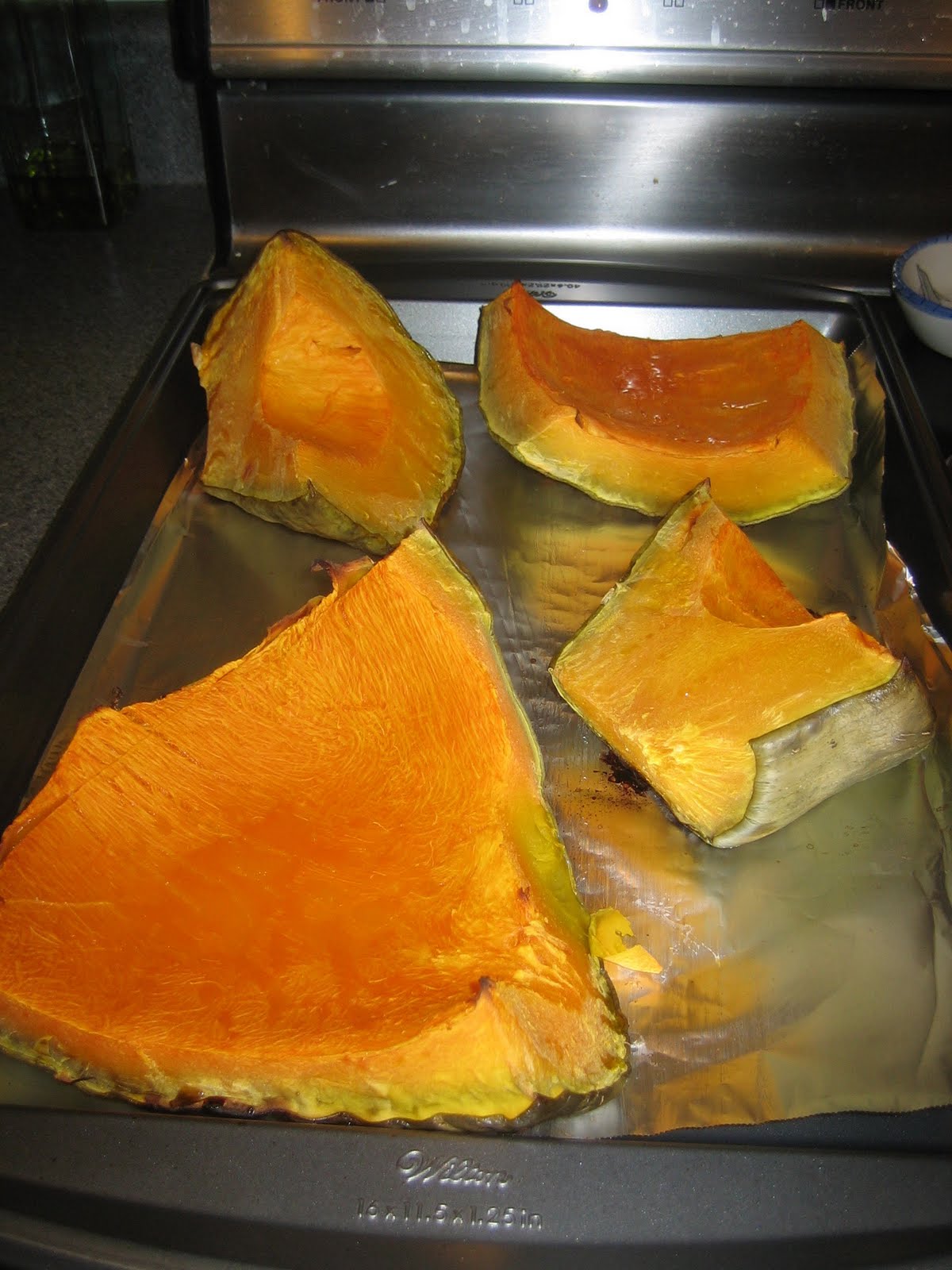
Step 2: Scoop out the seeds and pulp and discard. Chop the squash into smaller pieces and arrange with the rind facing down on foil (or Silpat) lined baking sheets.


Step 3: Roast in a 375° oven for about 90 minutes or until the squash is tender when poked with a fork.


Step 4: While the rind is still warm, scoop out the squash. Store in the freezer in a durable, airtight container, or sprinkle with a little cinnamon and brown sugar for a tasty treat fresh from the oven!


For a smaller squash, like a butternut, that you plan to finish off the same day, you will want to alter this recipe slightly. First, halve the squash and scoop out the seeds and gunk in the center. Arrange the halves rind down on a lined baking sheet. Brush the flesh of the squash with a little olive oil and sprinkle it with brown sugar (about 2 tsp). Roast the squash in a 400° oven for about 25 minutes, until you can easily stick a fork into it.

Smoky Squash Soup

Servings: About 6 bowlfulls.
Prep time: 10 min.
Cook time: 35 min.

1 large onion, chopped
4-5 large leaves of chard, coarsely chopped
2-3 jalapenos, diced
4-5 cloves of minced garlic
5 medium red potatoes, coarsely chopped
2 cups pureed cooked squash or 1 cup canned pumpkin
1 (15 oz.) can pinto beans
4 cups vegetable broth
1 Tbsp olive oil
1 Tbsp oregano
1 tsp chili powder
1 tsp chipotle powder
Pinch of cayenne pepper
1/2 teaspoon cumin
1/3 cup soy milk
Chopped cilantro or parsley (optional topping)

Notes:

- If using frozen roasted squash, let it thaw overnight and then puree it in a food processor. A blender can be used in a pinch, but then chop the roasted squash into smaller pieces first. Alternatively, you can follow these directions for microwaving a sugar pumpkin to create the pumpkin puree or use canned pumpkin, which can be found in most grocery stores.

- Despite all the spices, we have never found this dish to be spicy. If you really don’t like spicy food, you can use less of the chili and chipotle powders and skip the cayenne pepper.

Directions:

1. Chop all vegetables; set aside onions and garlic.

2. In a pot or large skillet with high sides, saute onions and chard in olive oil over medium-high heat for several minutes, until onions become translucent. Add garlic and cook about a minute.

3. Add broth, squash, potatoes, jalapenos, and beans. Stir in oregano, chili and chipotle powder, cumin, and cayenne pepper. Bring to a boil; then reduce heat and simmer for 30 min.

4. Remove from heat, and let cool for several minutes. Then, stir in soy milk. Top with parsley or cilantro and serve.


All of these recipes were developed with help and inspiration from some other hard-working food bloggers. You can check the original soup recipe at Fat Free Vegan Kitchen and some more info on the Blue Hubbard squash from Dave's Cupboard.